Condo vs Condex in NH: Differences to Know Now
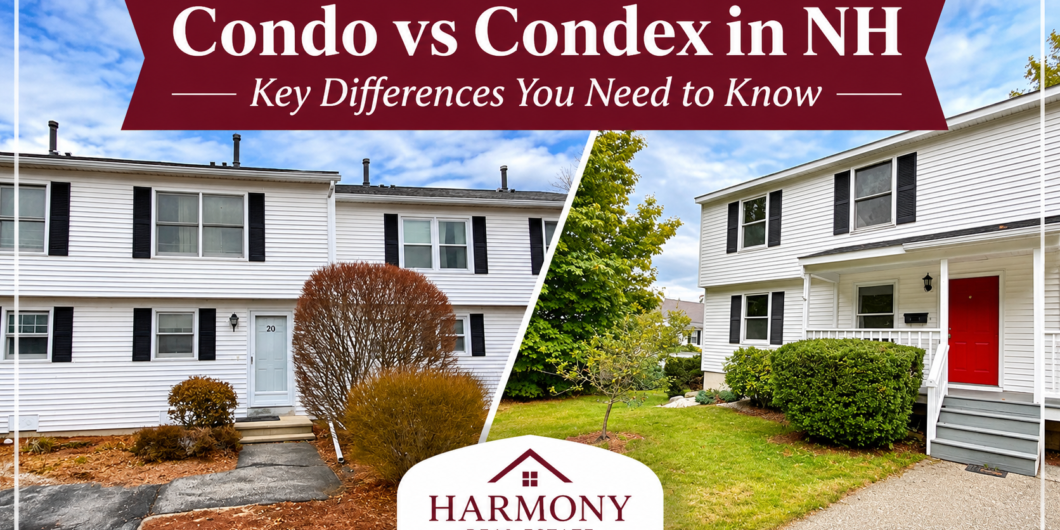
Condo vs Condex in NH: Key Differences You Need to Know
If you are searching for a home in New Hampshire, you may wonder about the difference between a Condo vs Condex. Both offer an alternative to a traditional single family home. However, ownership, maintenance, financing, and monthly costs can be quite different. Understanding these details before buying can help you avoid expensive surprises.
Buyers exploring Southern New Hampshire homes for sale often find condos and condexes in similar price ranges. At first glance, these properties may even look alike. However, their ownership responsibilities can be very different.
At Harmony Real Estate, our agents have helped buyers and sellers with condos, condexes, detached condos, and other residential properties throughout Southern New Hampshire. Through these transactions, we have learned that buyers need to look beyond the listing photos and asking price. The condominium documents can make a big difference.
What Is the Difference Between a Condo and a Condex in New Hampshire?
The biggest difference between a condo and a condex is usually the number of units and how the property operates. A traditional condo often belongs to a larger community with several units. Meanwhile, a condex typically contains just two units within one building or condominium property.
However, a condex is generally a type of condominium, not a separate legal form of ownership. In New Hampshire, the recorded condominium documents determine the legal structure. Therefore, buyers should never rely on the property description alone.
For example, a condo may have an association that handles landscaping, snow removal, and exterior repairs. A condex may have only two owners who share these responsibilities. As a result, the monthly costs and daily maintenance can be very different.
Quick Comparison of Condo vs Condex
FeatureTraditional CondoCondexNumber of unitsOften several or moreUsually twoOwnershipIndividual unit plus shared interestsIndividual unit plus shared interestsAssociationOften professionally managedOften managed by two ownersMonthly feesUsually regular feesMay have low or no regular feesExterior maintenanceOften handled by associationOften shared by ownersLandscapingMay be includedDepends on documentsInsuranceAssociation and unit policiesDepends on documents and coverageFinancingSubject to lender and project rulesSubject to lender and project rulesDecision makingAssociation or boardOften requires cooperation between two ownersResaleDepends on market and associationDepends on market and shared obligations
Although these differences are common, every property is unique. Therefore, reviewing the condominium declaration, bylaws, and other documents is essential.
What Is a Condo in New Hampshire?
A condominium is a form of property ownership. When you purchase a condo, you own your individual unit and share certain property interests with other owners. Buyers comparing Hudson NH condos for sale should review association fees, amenities, and maintenance responsibilities before making an offer.
For example, common areas may include driveways, parking lots, lawns, hallways, or recreational facilities. However, the exact boundaries of ownership depend on the recorded documents.
Many New Hampshire condo communities have an association that collects fees and manages shared expenses. In addition, the association may establish rules about parking, pets, exterior changes, and property use.
Some communities include swimming pools, tennis courts, walking trails, or clubhouses. Others provide only basic services, such as landscaping and snow removal.
Consequently, two condos with similar asking prices may have very different monthly ownership costs.
What Do Condo Fees Cover?
Condo fees vary by community. However, they commonly help pay for shared property expenses.
These expenses may include landscaping, snow removal, master insurance, common area electricity, trash removal, and reserve funds. Some associations also cover exterior repairs, roofing, and siding.
For example, a buyer might purchase a condo with a $350 monthly association fee. That fee could cover several services the buyer would otherwise pay for separately.
However, another association may charge $200 per month while covering fewer expenses. Therefore, comparing fees without reviewing the services can be misleading.
Before purchasing, buyers should review the association budget, insurance information, reserve funds, and maintenance responsibilities.
What Is a Condex in New Hampshire?
A condex is a common real estate term used to describe a two unit condominium property. The building often resembles a duplex, with each side owned separately.
Our agents have represented buyers purchasing condexes throughout Hudson. Buyers exploring Hudson NH homes for sale may find condos, condexes, and single family homes with different ownership arrangements.
Unlike larger condo developments, a condex often has no professional management company. Instead, the two owners handle shared decisions themselves.
For example, one owner may mow the front lawn while the other maintains the back. Alternatively, each owner may maintain an assigned yard area.
However, these arrangements should match the recorded documents or a clear written agreement. Otherwise, disagreements can become expensive.
Does a Condex Have an HOA?
Yes, a condex generally has a condominium association structure, even when it has no monthly fee. However, how that association operates can vary significantly.
Some associations collect money only when expenses arise. Others maintain a shared account for insurance, repairs, or future maintenance.
For example, two owners may share the cost of a roof replacement. If the roof costs $20,000, each owner might pay $10,000 when the documents require an equal split.
However, if one owner cannot afford the expense, repairs may become difficult. Therefore, reviewing the financial arrangements before purchasing is important.
A condex with no monthly fee does not necessarily mean lower ownership costs. Instead, owners may need to budget independently for future expenses.
Harmony Real Estate’s Experience With Condex Sales
Our agents have represented buyers and sellers in condex transactions throughout Southern New Hampshire.
For example, our office has helped buyers purchase condexes on Bush Hill Road, Lenny Lane, Greeley Street, Old Derry Road, and Derry Street in Hudson. We have also represented buyers in Plaistow and sellers in Hudson, Milford, and Nashua.
Through these transactions, our agents have gained practical experience with condominium documents, financing options, and shared property responsibilities.
Although condexes may look similar, their legal documents and ownership arrangements can differ. Therefore, understanding the details of each property is essential.
Condo vs Condex: Who Owns the Land?
One of the biggest misconceptions about condexes involves land ownership.
Many buyers assume that purchasing one side of a condex means they own the land on that side. However, that is not always true.
In a typical condominium, owners hold title to their individual units and an interest in the common property. The condominium declaration determines which areas belong to each unit.
For example, a condex may have a large backyard divided by a fence. Each owner may use a separate portion of the yard.
However, the fence does not necessarily establish a legal property boundary. The land may remain common property, with each owner receiving exclusive use of a designated area.
These areas are sometimes called limited common areas.
Why Land Ownership Matters
Land ownership can affect what improvements you can make. For example, you may want to install a fence, shed, patio, or swimming pool.
However, the condominium documents may require approval before making changes. In addition, local zoning rules and permits may apply.
Therefore, buyers should review the recorded site plan and condominium declaration. These documents help explain ownership boundaries and property rights.
If you are buying a condex in Hudson, Nashua, Litchfield, or another Southern NH town, ask about the land before making assumptions.
Condo vs Condex: Maintenance and Repairs
Maintenance is one of the most important differences buyers should understand.
In many traditional condo communities, the association handles common exterior maintenance. As a result, owners may spend less time managing landscaping, snow removal, and major building repairs.
However, a condex may place more responsibility on individual owners.
For example, one condex owner may be responsible for maintaining their side of the building. Meanwhile, both owners may share expenses for the roof or foundation.
The exact arrangement depends on the condominium documents.
What Happens When a Condex Needs a New Roof?
Imagine purchasing one side of a condex with an aging roof. A few years later, the roof begins leaking.
If the roof is a shared responsibility, both owners may need to contribute toward replacement. However, what happens if your neighbor disagrees?
This is where a two unit condominium can become complicated.
Unlike a larger association with reserve funds, a small condex may have little money available for major repairs. Therefore, owners may need to follow the governing documents to resolve disagreements about the cost and timing.
Before buying, ask about the roof’s age, past repairs, and future maintenance plans. In addition, review how the documents address shared expenses and disputes.
A lower monthly fee can be attractive. However, it should never replace proper planning.
Are Condexes Cheaper Than Condos in New Hampshire?
Not necessarily. The price depends on the location, size, condition, features, and current housing market.
For example, a condex in Hudson may offer three bedrooms, a garage, and a private yard area. Meanwhile, a condo in Nashua may offer two bedrooms with shared parking and community amenities.
Although both properties may have similar asking prices, the total ownership costs could differ.
A condex may have no regular monthly association fee. However, the owner may pay separately for landscaping, snow removal, exterior repairs, and other expenses.
A traditional condo may charge a monthly fee that includes several of these services.
Therefore, buyers should compare the complete monthly budget rather than focusing only on the purchase price.
Compare the Total Cost of Ownership
When comparing a condo and a condex, consider the mortgage payment, property taxes, insurance, association fees, utilities, and expected maintenance.
For example, a $300 monthly condo fee equals $3,600 annually. However, that amount may cover expenses a condex owner must pay independently.
Likewise, a condex without monthly fees may still require thousands of dollars in future repairs.
As a result, the property with the lowest monthly fee is not always the most affordable choice.
Is It Harder to Get a Mortgage on a Condex?
Financing a condex can sometimes be more complicated than financing a traditional single family home.
Although a condex may look like a duplex, lenders generally evaluate it as a condominium. Therefore, the lender may review both the buyer’s qualifications and the condominium project.
Depending on the loan program, the lender may request association documents, insurance information, budgets, or details about shared maintenance.
However, certain small condominium projects may qualify for exceptions from standard project review requirements.
The rules vary by lender and mortgage program.
FHA vs Conventional Financing for Condexes
In our experience, conventional financing has often been the more straightforward option for condex buyers. However, FHA financing may also be available when the condominium meets the applicable requirements.
For example, Harmony Real Estate represented the sellers of two condex units on Summer Street in Nashua. One buyer obtained FHA financing, while the other needed conventional financing because of the FHA requirements applied to that project.
This transaction demonstrates why financing should be discussed early in the buying process.
FHA condominium financing has specific project approval requirements. In addition, FHA concentration limits and other eligibility rules can affect financing availability.
Conventional financing may offer another option. Certain two unit condominium projects may qualify for exceptions from standard project review requirements.
However, buyers must still meet the lender’s credit, income, down payment, insurance, and property requirements.
Therefore, buyers should speak with a lender familiar with New Hampshire condominium financing before making an offer.
New Hampshire Housing Programs for Condex Buyers
First time homebuyers may have more financing options than they realize. New Hampshire Housing offers mortgage programs that can help eligible buyers with down payments and closing costs.
For example, Harmony Real Estate represented a buyer purchasing 56 Kingston Road, Unit B in Plaistow. The buyer used a New Hampshire Housing conventional mortgage program with down payment assistance to complete the purchase.
This transaction is a good example of why buyers should explore their financing options before assuming they cannot afford a home.
In 2026, eligible buyers may qualify for New Hampshire Housing down payment assistance through participating lenders. However, program amounts, repayment terms, and eligibility requirements can change.
Therefore, buyers should confirm current program details with an approved lender.
For buyers searching for condexes in Plaistow, Hudson, Nashua, or surrounding towns, exploring these programs early may provide additional opportunities.
Condo vs Condex: Insurance Requirements
Insurance is another important part of condominium ownership.
In a larger condo development, the association often maintains a master insurance policy. Meanwhile, individual owners purchase coverage for their personal property, liability, and any building items not covered by the master policy.
However, condex insurance arrangements can be different.
For example, a two unit condex may have a shared master policy covering the building. Alternatively, the governing documents may establish other insurance responsibilities.
The correct insurance arrangement depends on the condominium documents, applicable requirements, and lender guidelines.
Why Insurance Can Affect Your Mortgage
Mortgage lenders usually require proof of acceptable insurance before closing.
If the policy does not provide the required coverage, the lender may delay or deny financing.
Therefore, buyers should contact an insurance professional familiar with New Hampshire condominiums. In addition, the lender should review the coverage early in the transaction.
This is especially important when buying a condex without professional association management.
Property Taxes on Condos and Condexes in NH
Property taxes are a major expense for New Hampshire homeowners. Both condos and condexes are generally subject to local property taxes.
The municipality assesses each taxable property based on its valuation methods. Therefore, two similar units may have different assessments and tax bills.
For example, a condex in Hudson may have different annual taxes than a comparable condo in Nashua. Local tax rates and assessed values can make a significant difference.
Before purchasing, buyers should review the current tax bill and understand that assessments and tax rates may change.
What Happens to Taxes When a Duplex Becomes a Condex?
This is especially important when a duplex is converted into separate condominium units.
For example, Harmony Real Estate listed two condex units on Summer Street in Nashua that had previously been one duplex.
Before the conversion, the property had one tax bill. However, the new condominium units required separate assessments.
As a result, buyers needed to understand that their future property taxes could change once the city assessed each unit individually.
Therefore, buyers should never assume that half of the original duplex tax bill will equal their future property taxes.
Can You Make Changes to a Condex?
Many buyers like condexes because they often feel more like single family homes. Some offer separate entrances, attached garages, decks, and private outdoor spaces.
However, owning a condex does not automatically give you complete freedom to make changes.
For example, replacing windows, changing siding, adding a fence, or building a deck may require approval. The condominium documents determine which improvements need consent.
In addition, local building codes and zoning rules still apply.
Therefore, review the association rules before planning major improvements.
What About Pets, Parking, and Rentals?
Condominium documents may also regulate pets, parking, and rental use.
For example, some associations limit the number of pets or require approval for certain improvements. Others have restrictions on short term rentals or parking recreational vehicles.
Condexes can have similar restrictions, even with only two owners.
As a result, buyers should never assume that a small association means fewer rules.
Selling a Condex in Hudson, Nashua, or Milford
Selling a condex involves more than pricing the property and scheduling showings. Buyers may need information about shared maintenance, association documents, insurance, and financing requirements.
For example, Harmony Real Estate has listed condex properties at 87 Pelham Road, Unit A and 9A David Drive in Hudson. Our office has also listed 37 Greatbrook Road in Milford and two condex units on Summer Street in Nashua.
These transactions highlight the importance of understanding each property’s condominium structure before marketing it. Although two condexes may look similar, their ownership responsibilities and association arrangements can differ.
Therefore, sellers should gather condominium documents, insurance information, and details about shared expenses before listing.
In a larger condo development, the management company may provide much of this information. However, a condex seller may need to gather documents directly.
Preparing a Condex for Sale
If you are selling a condex in New Hampshire, start by reviewing your condominium documents.
Next, gather information about shared expenses, insurance, repairs, and any agreements with the other owner.
For example, if you share a septic system, buyers will want to understand maintenance and replacement responsibilities.
Likewise, if the roof or driveway is shared, explain how costs are divided.
Providing clear information early can help buyers feel more confident. In addition, it may reduce financing delays and unexpected problems during the transaction.
Does a Condex Have a Lower Resale Value?
A condex does not automatically have a lower resale value than a traditional condo.
Instead, buyers consider the location, condition, size, layout, amenities, and ownership costs.
For example, a well maintained condex with a garage and spacious yard may appeal to buyers seeking more privacy. Meanwhile, a condo with professional management may attract buyers who prefer less maintenance.
However, unclear maintenance agreements or financing problems can limit buyer interest.
Therefore, good records and clear responsibilities can help protect resale appeal.
What Should Buyers Review Before Purchasing a Condex?
Buying a condex requires careful review of both the unit and the shared property.
First, request the condominium declaration, bylaws, site plans, and applicable rules. These documents explain ownership, maintenance, and shared responsibilities.
Next, ask about association finances and insurance. Even if there are no monthly fees, you should understand how major expenses are handled.
Finally, review the condition of shared features, such as roofing, foundations, driveways, and septic systems.
Important Questions to Ask Before Buying
Who pays for the roof? Determine whether the roof is maintained separately or jointly.
Who maintains the yard? Review whether landscaping areas are assigned to individual owners.
Is there a monthly condo fee? If not, ask how the owners fund shared expenses.
Is there a reserve account? Find out whether money has been saved for future repairs.
Who handles snow removal? Confirm whether the driveway is shared and who pays for plowing.
Are there rental restrictions? Review the documents before assuming you can rent the property.
Is the building properly insured? Have your lender and insurance professional review the coverage.
Are there shared utilities or systems? Ask about septic systems, wells, water lines, and other shared equipment.
Are there any disputes or unpaid expenses? Ask about known disagreements, outstanding assessments, and maintenance concerns.
Will the property qualify for financing? Speak with your lender before making an offer.
These questions can help you avoid surprises after closing. More importantly, they help you understand what you are actually purchasing.
Condo vs Condex: Which Is Better for First Time Homebuyers?
First time homebuyers often consider condos and condexes because they may cost less than some single family homes.
However, the purchase price is only one part of the decision.
For example, a traditional condo may offer regular monthly association fees and fewer maintenance tasks. This can help buyers plan their expenses.
Meanwhile, a condex may offer more outdoor space, privacy, or room for future improvements.
However, buyers may also take on more responsibility for shared repairs.
Therefore, first time buyers should consider their savings, maintenance experience, and long term plans before choosing.
A home that fits your monthly budget today should also fit your financial plans tomorrow.
Is a Condex the Same as a Duplex?
No. Although a condex and duplex may look nearly identical, the ownership structure can be different.
A traditional duplex often consists of one property with two living units under one ownership. For example, an investor may purchase the entire building and rent both units.
A condex generally consists of two separately owned condominium units. Each owner holds title to their own unit and shares certain property interests.
As a result, a buyer purchasing one side of a condex usually cannot control the entire building.
However, a buyer purchasing a duplex may own both units and the land, depending on the property.
This distinction is especially important when searching for multifamily homes in New Hampshire.
Can a Duplex Be Converted Into Two Condexes?
In some cases, yes. However, converting a duplex into separate condominium units involves legal paperwork, recorded documents, and applicable local requirements.
For example, Harmony Real Estate listed 4A and 4B Summer Street in Nashua following a duplex conversion. The two units sold separately for $275,000 and $285,000, totaling $560,000.
The conversion required legal assistance and additional expenses. However, selling the units separately created a different opportunity than selling the property as one duplex.
Property owners considering a similar conversion should evaluate the potential sales value, legal costs, financing requirements, and tax implications before moving forward.
Common Questions About Condo vs Condex in NH
Is a Condex Considered a Condo in New Hampshire?
Yes. A condex is generally a two unit condominium. Therefore, condominium ownership rules and recorded governing documents apply.
Can a Condex Have No Condo Fees?
Yes. Some condex associations do not collect regular monthly fees. However, owners may still share expenses for insurance, maintenance, and major repairs.
Do You Own Your Yard With a Condex?
Not always. The land may be common property with exclusive use areas assigned to each unit. Therefore, review the condominium declaration and site plan.
Can You Get an FHA or Conventional Mortgage on a Condex?
Yes, financing may be available for eligible properties. However, FHA and conventional loans have different condominium requirements. Buyers should confirm eligibility with their lender.
Who Pays for Repairs on a Condex?
The condominium documents determine maintenance responsibilities. Some repairs may belong to individual owners, while others may be shared.
Is a Condex a Good Investment?
A condex can be a good investment when the location, condition, price, financing, and ownership responsibilities make sense. However, buyers should review rental rules and shared expenses carefully.
Can One Condex Owner Make Decisions Without the Other?
Some decisions may be made independently. However, changes involving common property or shared expenses may require approval under the condominium documents.
Are Condexes Harder to Sell?
Not necessarily. A well maintained condex with clear documents and acceptable financing options can attract buyers. However, unresolved maintenance or insurance problems may complicate a sale.
Finding the Right Condo or Condex in Southern New Hampshire
Choosing between a condo and a condex involves more than comparing bedrooms, bathrooms, and square footage. For example, a condex in Hudson may offer three bedrooms, a garage, and a private yard area. Meanwhile, buyers searching for Nashua NH homes for sale may find condos with shared parking, community amenities, and different maintenance costs.
Although both properties can offer excellent opportunities, their ownership responsibilities may be very different. Therefore, understanding the legal documents, financing requirements, and maintenance costs is essential.
Through our experience with New Hampshire real estate transactions, our agents understand that some of the most important questions involve expenses buyers cannot see during a showing. Shared roofs, insurance policies, reserve funds, and maintenance agreements can affect the true cost of ownership.
At Harmony Real Estate, we help buyers and sellers navigate condos, condexes, detached condos, single family homes, and multifamily properties throughout Southern New Hampshire.
Whether you are buying your first home, downsizing, investing, or preparing to sell, our agents can help you understand your options and make informed decisions.
If you are considering buying or selling a condo or condex in Hudson, Nashua, Plaistow, Milford, Litchfield, Londonderry, Derry, or a nearby community, contact Harmony Real Estate.
Visit http://www.southernnhhouseforsale.com to connect with our office and learn more about buying or selling real estate in Southern New Hampshire.